1

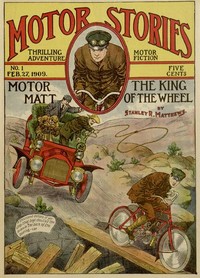
Motor Matt; or, The King of the Wheel Motor Stories Thrilling Adventure Motor Fiction No 1. — Story, Setting & Ideas
(0 User reviews)
479
Project Gutenberg
2014
Not confirmed
Adventure stories; Dime novels; Motorcycles -- Juvenile fiction; Inventors -- Juvenile fiction; Mechanics -- Juvenile fiction
Readers of public-domain and historical texts
Project Gutenberg digital edition
en
Edition facts
Words
36,836
Reading time
161 min
Text sections
4
The catalog record for Motor Matt; or, The King of the Wheel Motor Stories Thrilling Adventure Motor Fiction No 1. — Story, Setting & Ideas provides practical reading context through 36,836 words, 2 hr 41 min estimated reading time, and 4 detected text sections.
The text analysis averages about 14.7 words per sentence, while the detected sections provide another way to judge how the source is divided.
Project Gutenberg metadata also associates the work with “Adventure stories,” connecting these edition facts with the source record’s subject description.
Source:
Project Gutenberg record #46075
This editorial note examines the language, narrative voice, and pacing in Stanley R. Matthews' 1909 dime novel, focusing on the opening encounter between Susie and Dace Perry, the distinctive speech of Welcome Perkins, and the shift from banter to tense plotting.
Read the complete public-domain text at its original source.
Read on Project GutenbergThe first chapter of Motor Matt; or, The King of the Wheel opens with a jarring greeting: “Hello, peaches!” The line, spoken by a boy in running-togs, immediately establishes a tone of casual aggression. The girl, Susie, responds with wariness, and the dialogue quickly reveals a power dynamic—Dace Perry, captain of the high school cross-country team, presses his familiarity while Susie rebuffs him. The exchange is brisk, with short sentences and panting breath, setting a pace that mirrors Perry’s trot. This opening is not merely expository; it uses voice and rhythm to signal conflict before any plot machinery engages.
Voice as a Marker of Character
The excerpts showcase distinct speech patterns that define characters without heavy description. Dace Perry’s dialogue is laced with bravado and condescension: “Don’t be so bashful, Susie; I won’t bite, honest.” His words are quick, self-assured, and meant to dominate. Susie’s replies are measured and cutting: “If all I’ve heard of you is true, you’re more given to barking than anything else.” The contrast is sharp—Perry’s breathless, grinning chatter versus Susie’s quiet, deliberate retorts. Later, Welcome Perkins erupts with a torrent of hyperbolic, dialect-heavy speech: “Whoop! … it’s a wonder ye wouldn’t look where ye’re goin’—runnin’ inter a one-legged ole pirate like a cyclone.” His language is a performance in itself, full of exclamations and self-dramatizing references to “Lucretia Borgia” (his revolver). These voices do not merely convey information; they embody the characters’ social positions and temperaments, making the narrative feel immediate and theatrical.
Pacing Shifts from Banter to Conspiracy
The narrative’s rhythm changes markedly between the opening scene and the later chapters. The first chapter moves at a conversational clip, with rapid back-and-forth dialogue and physical action (Perry trotting, Susie stepping back). The sentences are short, and the scene feels almost stagey. By Chapter XI, however, the pace slows and tightens. Welcome’s whispered revelation about a fixed race is delivered in halting, gulping phrases: “I don’t b’leeve in gamblin’ … but that’s what Dirk Hawley is doin’—bettin’ right an’ left … that O’Day’ll win that race to-morrer!” The urgency is conveyed through fragmented syntax and Welcome’s convulsive grip on Matt’s arm. The narrator then steps back with a measured observation: “Matt was startled. He might easily have inferred that Welcome was making a mountain out of a mole-hill … but for the fact that there was evidence to support Welcome’s story.” This shift from breathless dialogue to reflective summary signals a change from social sparring to genuine plotting, giving the reader a moment to absorb the stakes.
Recurring Motifs and Structural Repetition
Several details recur across the excerpts, creating a pattern that reinforces the dime-novel style. The phrase “cut loose” appears twice in Welcome’s speech, first as a threat (“I got so heathen mad I come purty nigh fallin’ from grace … an’ damaging every one in sight”) and later as a confession (“I got in a twitter … an’ I a’most hate to tell ye how I cut loose, Matt”). This repetition ties Welcome’s volatile nature to the story’s central conflict. Similarly, the motif of “barking” versus “biting” appears in Susie’s retort to Perry and echoes in the later discussion of Hawley’s betting—where talk of “throwing the race” implies a kind of bark without bite. The narrative also uses physical props as shorthand: the revolver “Lucretia Borgia” is named twice, lending a mock-heroic weight to Welcome’s threats. These recurring elements give the text a cohesive, almost formulaic energy, typical of serial adventure fiction but executed with a specific verbal flair.
Readers approaching this dime novel should attend to the way Matthews builds tension through voice alone. The opening’s snappy repartee gives way to conspiratorial whispers, and the shift is marked not by scene breaks but by changes in sentence rhythm and diction. Welcome Perkins’s dialect is a key—his hyperbole often signals danger, while Matt’s calm responses ground the narrative. The excerpts suggest a story that moves as fast as its motorcycles, but the real engine is the characters’ talk.
Some mornings I think of Dace Perry’s restless speed, that anxious pedal-to-the-metal cadence, and how it quiets when it meets The Vicomte de Bragelonne — a slower, older patience where loyalty rusts gently. The Vicomte de Bragelonne — Themes and Context shares that hush between breathless lines, a shared wink about men who chase what time has already decided to give them.
There are no reviews for this eBook.
There are no comments for this eBook.
Reader reflection
Record your reading impressions
A brief reflection can help important ideas stay with you longer.
Your progress
0
/
10
2
Did this book hold your interest?
3
Would you recommend this book to another reader?
4
How much effort did this book require?
5
How well did it match your expectations?
6
Would you start a conversation about this book?
7
How strongly did the book affect you emotionally?
8
What was the strongest part of the book?
9
In one sentence, what did you learn?
10