1

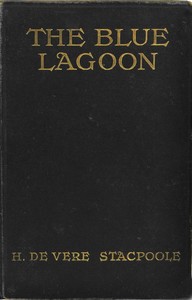
The Blue Lagoon: A Romance — Themes and Context
(0 User reviews)
88
Project Gutenberg
1996
Not confirmed
Islands -- Fiction; Love stories; Bildungsromans; Cousins -- Fiction; Adventure stories; Shipwrecks -- Fiction; Castaways -- Fiction
Readers of public-domain and historical texts
Project Gutenberg digital edition
en
Edition facts
Words
69,353
Reading time
302 min
Text sections
9
The catalog record for The Blue Lagoon: A Romance — Themes and Context provides practical reading context through 69,353 words, 5 hr 2 min estimated reading time, and 9 detected text sections.
The text analysis averages about 19.5 words per sentence, while the detected sections provide another way to judge how the source is divided.
Project Gutenberg metadata also associates the work with “Islands -- Fiction,” connecting these edition facts with the source record’s subject description.
Source:
Project Gutenberg record #393
An editorial note examining the structural movement between shipboard and island scenes, the recurring image of the blue lagoon as a boundary, and the shift from childlike to adult perception in H. De Vere Stacpoole's romance.
Read the complete public-domain text at its original source.
Read on Project GutenbergThe Blue Lagoon opens not on a tropical shore but in the fo'c'sle of a ship, where the fiddler Mr Button plays the “Shan van vaught” under a slush lamp. This initial setting—cramped, kerosene-lit, peopled by a sailor who still carries fairies from Connaught—establishes a world of contained motion. The narrative then moves abruptly to an island, and the reader must track how the story shifts between these two environments: the confined social space of the ship and the open, unsupervised island. The table of contents reinforces this binary, dividing the book into two books, each with parts that alternate between shipboard and island chapters.
The Fo'c'sle as a Frame
The first chapter, “Where the Slush Lamp Burns,” is dense with sensory detail: the fiddle’s tune, the swinging hammocks that “called up suggestions of lemurs and arboreal bats,” the green baize jacket stained by sun and salt. This is not a generic shipboard scene; it is a specific, almost ethnographic portrait of a sailor’s world. Mr Button is described with a crab-like figure, and his playing is accompanied by heel blows on the deck. The narrative lingers on the lamp’s light and the semi-gloom, creating a closed, womb-like space. This fo'c'sle serves as a framing device for the entire romance: the story of the castaways will be told against the backdrop of this maritime world, and the reader is meant to carry the memory of this cramped, kerosene-lit interior into the open-air island scenes that follow.
The Lagoon as a Dividing Line
The island is not a uniform paradise; it is divided by the lagoon, which functions as a psychological and physical boundary. After the “tragic occurrence on the reef,” the children “kept entirely to the back of the island and the woods—the lagoon, down to a certain point, and the reef.” The lagoon becomes a barrier they will not cross, a place associated with death and mystery. Stacpoole reinforces this by naming the book after the lagoon and by giving it a color: “the Lake of Azure.” The blue is not merely descriptive; it carries a sense of allure and danger. The reef, too, is a threshold: Dick occasionally ventures to the old place in the dinghy, but Emmeline refuses. The narrative thus builds a geography of avoidance, where the most beautiful feature of the island is also the most charged.
Time Marked by Seasons and Growth
The passage of time on the island is measured not by clocks but by natural cycles and physical changes. “Five rainy seasons had passed and gone” after the reef incident, and the children have aged into young adults. Emmeline’s transformation is described as sudden: “the whole thing, as far as the beauty of her was concerned, had happened during the last six months.” Dick, meanwhile, has built three houses in succession, laid out taro and sweet potato patches, and studied the reef’s inhabitants. The narrative tracks their development through concrete actions—cutting canes, asking the bird Koko for Dick’s whereabouts—rather than through introspection. This external focus keeps the reader grounded in the visible world, even as the characters approach adulthood and the story edges toward romance.
The Bird Koko as a Linking Device
Among the recurring details in the excerpts, the bird Koko stands out. It is a trained parrot that “formed its entire vocabulary” from a single sound, from which it derived its name. Koko appears in the island scenes as a domestic presence, roosting on the roof and appearing at meals. When Emmeline holds out her hand, the bird flies to her finger and balances, “sinking its head between its shoulders.” This small, repeated gesture—the bird perching on a finger—creates a visual motif of connection and trust. Koko also serves as a conversational prop: Emmeline asks the bird where Dick is, a remark “made by way of making conversation.” The bird thus bridges the human characters, providing a touch of the familiar in an unfamiliar world. Its presence hints at the domestic routines that the castaways have established.
Readers approaching The Blue Lagoon will find a narrative that moves deliberately between enclosed and open spaces, between the ship’s fo'c'sle and the island’s lagoon. Pay attention to how Stacpoole uses physical boundaries—the reef, the lagoon, the back of the island—to structure the characters’ experience. The story’s romance emerges not from dramatic plot turns but from the slow accumulation of seasonal changes, domestic routines, and the persistent presence of the blue lagoon itself.
That afternoon, the rain kept time against the window while I lingered over Stacpoole’s blue lagoon, that boundary between innocence and something harder. I kept thinking about thresholds—how a horizon can feel like a promise until you cross it. Later, half-asleep, I picked up The Forest Runners: A Story of the Great War Trail in Early Kentucky — Edition Insights and found the same quiet ache: a frontier, a boy, the weight of what isn’t said.
There are no reviews for this eBook.
There are no comments for this eBook.
Reader reflection
Your personal reading reflection
Build a private reading journal entry for this title.
Your progress
0
/
10
2
How did the book work for you overall?
3
Would you encourage someone else to read it?
4
What was the reading difficulty like?
5
Did the book meet your expectations?
6
How clear did the writing feel?
7
How useful were the ideas in this book?
8
How closely did the book connect with your experience?
9
What did this book teach you most?
10