
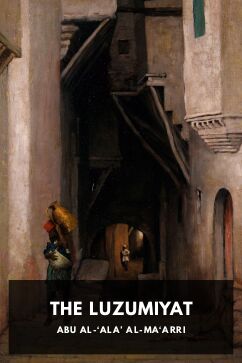
The Luzumiyat - Abu al-ʻAlaʼ al-Maʻarri
Let's be clear: 'The Luzumiyat' isn't a novel with a plot. It's a collection of short, powerful poems and philosophical musings. There's no hero's journey, just the journey of a single, remarkable intellect. Abu al-ʻAlaʼ al-Maʻarri, who lived from 973 to 1057, went blind as a child. He became a famous scholar, but chose a life of near-hermitage, refusing most honors and living simply. 'The Luzumiyat' (which roughly means 'The Necessities' or 'The Obligations') is his life's work, a record of his uncompromising thoughts.
The Story
Imagine a mind trapped in darkness, yet seeing the world more clearly than anyone around him. That's the 'story.' Through these verses, al-Maʻarri tackles the big stuff. He questions religious dogma, pointing out contradictions and the human tendency toward superstition. He laments the cruelty and ignorance he perceives in society. He even expresses a deep skepticism about the afterlife and proposes a radical compassion for all living creatures, advocating for vegetarianism long before it was a common idea. The 'narrative' is the progression of his ideas—from observation to doubt, to critique, and finally to a personal, ethical code built on reason and empathy.
Why You Should Read It
I picked this up out of historical curiosity and was shocked by how modern it felt. This isn't dusty, impenetrable verse. When al-Maʻarri writes about people blindly following tradition or using religion to justify power, it echoes conversations we have today. His voice is weary, often pessimistic, but it's cut with a brilliant, sarcastic humor. He doesn't offer easy answers; he dismantles the easy answers everyone else accepted. Reading him is bracing. It makes you sit up and question your own assumptions. In a world full of noise and certainty, there's something incredibly powerful about this quiet, ancient voice of doubt and reason.
Final Verdict
This book is not for everyone. If you're looking for a light, uplifting read, look elsewhere. But if you're a reader who loves philosophy, history, or poetry that punches way above its weight, this is a treasure. It's perfect for fans of skeptical thinkers from any era, for anyone interested in the Islamic Golden Age beyond just the science and math, and for readers who enjoy challenging, aphoristic writing like that of Nietzsche or Cioran, but from a completely different cultural wellspring. Prepare to be humbled and provoked by a mind that refused to look away.
Legal analysis indicates this work is in the public domain. Thank you for supporting open literature.
Sarah Garcia
11 months agoAs a professional in this niche, the bibliography and references suggest a high level of research and authority. Definitely a five-star contribution to the field.
David Miller
8 months agoI stumbled upon this title during my weekend research and the clarity of the writing makes even the most dense sections readable. This exceeded my expectations in almost every way.
Paul Thomas
1 year agoI particularly value the technical accuracy maintained throughout.
Karen Martin
6 months agoFrom a researcher's perspective, the narrative arc keeps the reader engaged while delivering factual content. I'm glad I chose this over the other alternatives.
Linda Harris
3 weeks agoI appreciate how this edition approaches the core problem, the formatting on mobile devices is surprisingly crisp and clear. A perfect balance of theory and practical advice.